barnes neville wallis: Complete Biography, Inventions, Career, and Engineering Legacy
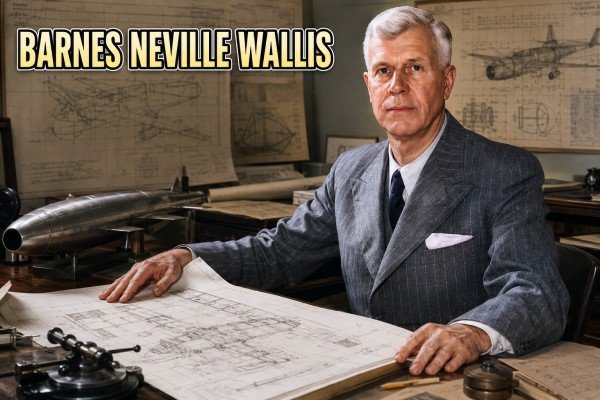
barnes neville wallis was a British engineer, inventor, and aeronautical designer whose work played an important role in the history of aviation and military engineering. He is most famous for creating the bouncing bomb used in the Dambusters Raid during the Second World War, but his full life story is much bigger than one invention. Wallis worked on airships, aircraft structures, geodetic design, deep-penetration bombs, and postwar aerospace research.
His career is important because it shows how practical engineering, mathematical thinking, and imagination can come together to solve difficult problems. From the early airship era to advanced aircraft research, Sir Barnes Neville Wallis remained connected with some of the most ambitious British engineering projects of the twentieth century.
Who Was Barnes Neville Wallis?
Barnes Neville Wallis was born on 26 September 1887 in Ripley, Derbyshire, England. He became one of Britain’s best-known aeronautical engineers and inventors. He worked for Vickers for much of his career and became closely associated with airship design, aircraft construction, and special wartime weapons.
He is best remembered by the public for the bouncing bomb, officially known as Upkeep, which was used by RAF No. 617 Squadron in Operation Chastise in May 1943. However, Wallis also made major contributions to the R100 airship, geodetic aircraft construction, the Vickers Wellington bomber, and the Tallboy and Grand Slam bombs.
Early Life and Family Background
Childhood in England
Barnes Wallis was born into a family that valued education, discipline, and hard work. His father, Charles Wallis, was a doctor, and his mother was Edith Ashby. When Wallis was still young, the family moved to London. His early life was affected by financial and family challenges, especially after his father suffered illness.
These difficulties did not stop Wallis from developing a serious interest in science, mathematics, and making things. He showed curiosity from an early age and later used that curiosity to build a career in practical engineering.
Education and Early Learning
Wallis attended Christ’s Hospital School and later continued his education through practical work and private study. Unlike many famous engineers who followed a traditional university path from the beginning, Wallis entered engineering through apprenticeship.
This practical route helped shape his mind. He learned not only from books but also from workshops, machines, drawings, and real engineering problems. Later, he earned an engineering degree through the University of London External Programme, giving him a strong combination of practical and theoretical knowledge.
Early Engineering Career
Apprenticeship and Marine Engineering
Wallis began his professional life as an apprentice at Thames Engineering Works. He later worked at J. Samuel White & Company in Cowes, where he gained experience in marine engineering and draughtsmanship. This early work gave him a foundation in structure, materials, mechanical design, and precision.
His marine engineering background was important because it taught him how to think about strength, weight, movement, and safety. These same ideas later became central to his work in aviation.
Joining Vickers
In 1913, Wallis joined Vickers, a major British engineering and aircraft company. This became the most important professional relationship of his life. At Vickers, he first worked on airships, then moved into aircraft structures and advanced aeronautical research.
His long association with Vickers allowed him to develop ideas over many years and apply them to real engineering projects.
Barnes Neville Wallis and Airship Design
Work on British Airships
Before he became famous for the bouncing bomb, Wallis made his name in airship design. He worked on several airship projects, including R9, R80, and later R100. At the time, airships were seen as a major part of the future of long-distance air travel.
Wallis helped develop lightweight structural ideas that were essential for large airships. Airships needed to be strong enough to survive flight but light enough to rise and travel efficiently. This challenge suited Wallis’s engineering mind.
The R100 Airship
The R100 was one of the most important projects in Wallis’s early career. It was part of Britain’s attempt to develop large rigid airships for long-distance travel. Wallis played a central role in its design.
Although the British airship programme ended after the R101 disaster in 1930, the R100 period was still important for Wallis. It helped him develop structural ideas that later influenced his aircraft work.
Geodetic Aircraft Design
What Is Geodetic Design?
One of Wallis’s greatest engineering achievements was his use of geodetic aircraft construction. This design used a crossing, basket-like framework of structural members. The result was a structure that could be strong, light, and efficient.
In simple words, geodetic design allowed an aircraft body or wing to carry loads through a woven pattern rather than relying only on heavy traditional frames. This made it useful for aircraft that needed strength without too much weight.
Vickers Wellesley and Wellington
Wallis used geodetic construction in aircraft such as the Vickers Wellesley and the Vickers Wellington. The Wellington bomber became especially famous during the Second World War.
The Wellington’s structure was admired because it could often withstand serious damage and still remain flyable. This helped prove the practical value of Wallis’s structural ideas. His work on geodetic design shows that he was not only a weapon inventor; he was also a serious aircraft structural engineer.
The Bouncing Bomb and the Dambusters Raid
How the Idea Developed
The invention most closely connected with barnes neville wallis is the bouncing bomb. During the Second World War, Britain needed new ways to attack heavily protected German targets. Wallis began working on a bomb that could bounce across water, pass over defensive nets, hit a dam wall, sink, and explode underwater.
The idea sounded unusual, but Wallis supported it with testing, calculation, and practical experiments. The bomb was designed to be dropped from a low-flying aircraft at a specific height and speed, with backspin to help it move correctly across the water.
Operation Chastise
The bouncing bomb was used in Operation Chastise on the night of 16–17 May 1943. RAF No. 617 Squadron, led by Wing Commander Guy Gibson, attacked dams in Germany’s Ruhr Valley. The Möhne and Eder dams were breached, while the Sorpe dam remained intact.
The raid became one of the most famous air operations of the Second World War. It also made Wallis a well-known name in British wartime history.
Human Cost of the Raid
A balanced biography must also mention the cost of the mission. Many RAF aircrew were killed, and people on the ground also died because of the flooding caused by the dam breaches. Wallis was deeply affected by the loss of life. This part of the story is important because it shows that wartime engineering was never only about technical success; it also carried serious human consequences.
Tallboy and Grand Slam Bombs
After the Dambusters Raid, Wallis continued developing special deep-penetration bombs. Two of the most famous were Tallboy and Grand Slam.
These bombs were sometimes called “earthquake bombs” because they were designed to penetrate deeply or create powerful shock effects against major targets. They were used against bridges, viaducts, submarine pens, and other heavily protected structures.
The Grand Slam was especially large and required specially modified Lancaster aircraft. These later weapons show Wallis’s continued interest in solving difficult military engineering problems through careful design.
Postwar Research and Advanced Aircraft Ideas
After the Second World War, Sir Barnes Neville Wallis continued working in aerospace research. He became interested in advanced flight concepts, including supersonic flight and variable-geometry aircraft, often known as swing-wing designs.
Projects such as Wild Goose and Swallow showed his interest in the future of aviation. Although not all of his postwar ideas became production aircraft, they demonstrated that Wallis continued thinking beyond the technology of his own time.
Personal Life
Barnes Wallis married Mary “Molly” Bloxam in 1925. The couple lived for many years in Effingham, Surrey. They had children and also took responsibility for adopted family members after tragedy affected relatives.
Wallis was known as a serious, disciplined, and thoughtful man. His personal life was closely connected with family, education, and service. After receiving money connected with his wartime work, he helped support educational causes linked to children of RAF personnel.
Honours and Recognition
Wallis received several major honours during his lifetime. He was appointed CBE in 1943, elected a Fellow of the Royal Society in 1945, and knighted in 1968. These honours reflected his importance in British engineering, aviation, and wartime innovation.
He died on 30 October 1979 in Surrey, England. Today, he is remembered as Sir Barnes Neville Wallis, a major figure in British engineering history.
Latest Legacy and Public Interest
Since Wallis died in 1979, the latest information about him is related to how his legacy is preserved. Museums, aviation historians, and engineering organizations continue to study his work. Brooklands Museum opened a permanent exhibition in 2023 focusing on his wider innovations, not only the bouncing bomb.
This modern recognition is important because it helps people understand the full story of Barnes Neville Wallis. He was not just the man behind one famous wartime weapon. He was an engineer whose work covered airships, aircraft structures, military technology, and future aerospace ideas.
Why Barnes Neville Wallis Still Matters
Barnes Neville Wallis still matters because his life shows the power of engineering creativity. He combined imagination with practical testing. He looked at difficult problems and searched for original solutions.
His career also teaches an important lesson: invention is not only about having a strange idea. It is about proving that the idea can work, improving it through testing, and turning it into something practical. That is why barnes neville wallis remains an important name in aviation, military history, and British engineering.
Quick Info About Barnes Neville Wallis
| Detail | Information |
|---|---|
| Full Name | Sir Barnes Neville Wallis |
| Main Keyword | barnes neville wallis |
| Related Keyword | sir barnes neville wallis |
| Born | 26 September 1887 |
| Birthplace | Ripley, Derbyshire, England |
| Died | 30 October 1979 |
| Nationality | British |
| Profession | Engineer, inventor, aeronautical designer |
| Famous For | Bouncing bomb, geodetic aircraft design, R100 airship, Tallboy, Grand Slam |
| Major Employer | Vickers |
| Major Aircraft Link | Vickers Wellington |
| Major Wartime Operation | Operation Chastise |
| Honours | CBE, Fellow of the Royal Society, Knight Bachelor |
FAQs About Barnes Neville Wallis
Who was barnes neville wallis?
Barnes Neville Wallis was a British engineer, inventor, and aeronautical designer best known for creating the bouncing bomb used in the Dambusters Raid during World War II.
What is Sir Barnes Neville Wallis famous for?
Sir Barnes Neville Wallis is famous for the bouncing bomb, but he is also remembered for geodetic aircraft design, the R100 airship, the Vickers Wellington bomber, and the Tallboy and Grand Slam bombs.
Did Barnes Neville Wallis invent the bouncing bomb?
Yes. Barnes Neville Wallis developed the bouncing bomb, officially called Upkeep, which was used by RAF No. 617 Squadron in Operation Chastise.
What was geodetic aircraft design?
Geodetic aircraft design was a lightweight and strong structural method using a crossing framework. Wallis used this idea in aircraft such as the Vickers Wellesley and Vickers Wellington.
Was Barnes Neville Wallis only a bomb designer?
No. He worked on airships, aircraft structures, geodetic construction, advanced bombs, and postwar aerospace ideas such as swing-wing aircraft.
When was Barnes Neville Wallis knighted?
Barnes Neville Wallis was knighted in 1968 for his services to engineering and aviation.
When did Barnes Neville Wallis die?
Barnes Neville Wallis died on 30 October 1979 in Surrey, England.
Why is barnes neville wallis important today?
He is important because his engineering work influenced aviation history, wartime technology, structural aircraft design, and later aerospace thinking.